Sutherland Astronomical Society - NACAA 2004 by Stephen Nugent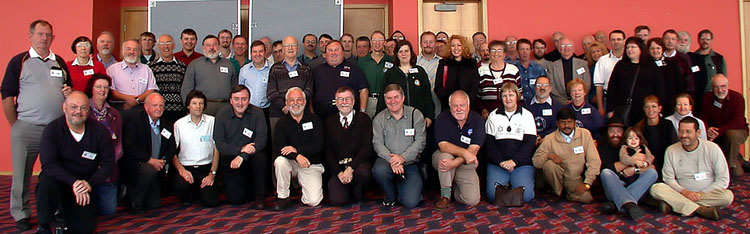 |
NACAA 2004 Conference Attendees. Photo courtesy of Shevill Mathers. |
|
The 21st National Australian Convention of Amateur Astronomers (NACAA 21) was held at the Wrest Point Hotel and Conference Centre from April 9th – 12th 2004. The Astronomical Society of Tasmania who did a superb job hosted the conference. The room I was given at the Wrest Point was excellent and the conference started on the Friday evening with a cocktail reception. As I went to register and pick up my satchel I wondered whether someone at the Wrest Point had a very good sense of humour. Just across the hall from the Wellington Room where NACCA was to be held someone had scheduled a Psychic fair for the same time! Needless to say this provided for some interesting comments at the cocktail reception. Saturday started the formal talks with the opening address given by Professor Fred Watson, always an entertaining speaker and this was no exception. The talk was titled “Star Wars – Astronomy with attitude” and dealt with controversies within astronomy and how heated some scientific debates can become. Historical arguments including how many of the star charts and constellations were drawn up proved to be fascinating. The talk finished with some of the current astronomical debates including such questions as “What is a planet?” with reference to brown dwarfs, extrasolar planets, spherical shaped minor planets and Kuiper Belt Objects. After morning tea, Michael Mattiazzo, Astronomical Society of South Australia, delivered a talk on the comets of 2004 and started with the announcement of the discovery of Comet Bradfield 18. Some interesting points of this talk were that the coma of a comet is mostly hydrogen gas coming from the decomposition of water molecules as they outgas from the nucleus. Comets are categorised into three groups, short period comets, which return within 30 years, long period comets, which take longer than 30 years to return, and the parabolic/hyperbolic comets that will never return. Ray Johnston, Great Barrier Reef Observatory, gave a very enjoyable talk titled “The Star of Bethlehem – Fact, Fiction, Myth or Miracle” and considering the Physic Fair was on next door to our conference warned us that this talk could “Contain a trace of Nuts”. This session finished with Dr Peter Norman outlining the structure of carbon within cooling white dwarfs and the formation of the largest diamond known.
Byron Soulsby, Canberra Astronomical Society, started the next section of talks speaking about the solar eclipse of 2006 and gave details of the centre line and the best places in Turkey to see Bailey’s Beads. Brett McMillan then spoke on the topic of amateur involvement in the recent IAU general assembly. Tom Richards gave a poster presentation describing how a Victorian era planetary scrapbook had been discovered by the ASV and outlined its historical significance. Ian Sullivan from the ASV spoke on the Transit of Venus 1874 and the use of the then latest technology of a photoheliograph. In the era of space missions and global positioning satellites this talk brought home the long history of how difficult and important the accurate determination of latitude and longitude was in the past. George Smith capped off the afternoon session with a workshop on mirror grinding. His unconventional grinding tools included the bottom of a stubbie which one must appropriately empty of its contents first! The final talk of the conference was delivered by John Perdrix, Astronomical Society of Western Australia, titled “Australian Amateur Astronomical Conventions III – Approaching Majority”. This talk looked at where NACAA has been and asked some pertinent questions as to where the direction of NACAA should be in the future. The conference was then closed by Shevill Mathers with the conference dinner following in the Derwent Room of the Wrest Point.
The reason for such intense observations of one object has been the study of “glitches” which occur when the pulsar suffers a star quake. From this study it has been determined that a glitch happens in less than 10 seconds and thus has significant consequences for the theoretical physics involved in neutron matter. This was my first NACAA and I thoroughly enjoyed the diversity of speakers and the pleasant surroundings in which it was held, it won’t be my last. The organising committee of NACAA 21 are to be congratulated. |